Problem Statement: Color Consistency Failure Across Wide Viewing Cones
Large curved signs and façades often exhibit perceptible color shift when viewers traverse the azimuthal plane; this remains a primary failure mode for any fixed outdoor display. The problem is measurable: as the effective viewing angle exceeds ±60°, spectral perceived chromaticity can deviate beyond just-noticeable-difference thresholds unless mitigated. Key variables are emitter angular distribution, curvature radius, pixel pitch and local luminance; together they determine the spatial uniformity of color and brightness on sites such as Times Square installations, where peak luminance commonly reaches into the thousands of nits during daytime operation.
Mechanisms: Optical and Electronic Origins of Color Shift
Color shift originates from two linked mechanisms. First, the angular emission profile of discrete LED modules causes spectral power distribution to change with viewing angle; spectral mismatch between red/green/blue dies yields hue rotation at oblique angles. Second, electronics and processing—gamma correction, color calibration LUTs and refresh rate interactions—introduce differential gain across color channels under non-normal incidence. Pixel pitch and module tiling accentuate spatial aliasing of these effects, producing visible banding or hue gradients on curved surfaces with tight curvature radius.
Design Interventions: Hardware Choices and Calibration Protocols
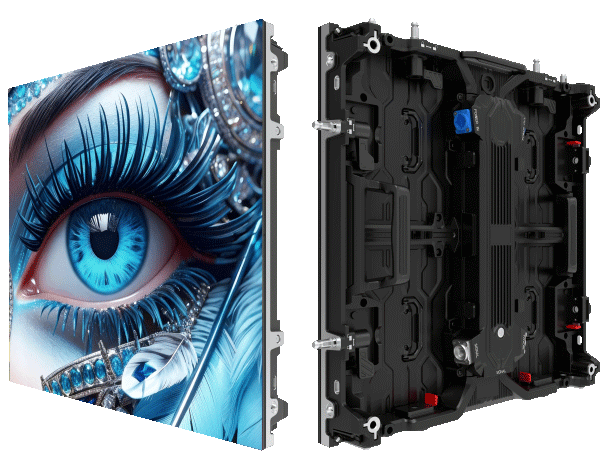
Effective mitigation requires combined hardware and software measures. Optical selection—LED dies with broader Lambertian profiles or secondary optics that homogenize off-axis spectral output—reduces raw angular chromaticity change. Mechanical layout that moderates module tilt relative to predominant sightlines limits extreme obliquity. Calibration must be multi-point and spatially dense: use camera-based photometric mapping across the full viewing cone, derive spatial LUTs, and apply per-module color correction rather than a single global curve. HDR workflows and dynamic backplane control can preserve highlight fidelity while maintaining chromatic consistency. For practical field examples, reference typical best practices for a led display outdoor deployment—uniformity targets, calibration intervals and environmental protection strategies.
Deployment Considerations and Common Mistakes
Common errors start in specification. Selecting pixel pitch solely for viewing distance without accounting for ambient luminance and viewing-angle distribution leads to poor perceived quality. Contractors often perform single-point calibration at center-normal incidence; the result: accurate color only at the calibration vector. Field teams sometimes prioritize peak nits over angular uniformity, producing acceptable daytime contrast but pronounced color shift off-axis—this is avoidable with balanced design. Also, neglecting thermal gradients across a curved array produces differential LED aging and drift—regular re-calibration compensates but does not replace correct thermal design. A short human note—the small choices matter as much as the big ones; alignment tolerances under millimeter scale change uniformity.
Evaluation Metrics and Three Golden Rules for Selection
Adopt these critical evaluation metrics when specifying or validating a wide-format curved installation: 1) Angular Chromaticity Delta (Δu’v’) measured at multiple azimuths and elevations; require values within perceptual tolerance (e.g., <0.005) across the primary viewing sector. 2) Spatial Luminance Uniformity: target ≥90% uniformity across the curved surface under nominal operating current and temperature. 3) Calibration Density and Recalibration Interval: define per-module LUT granularity and schedule automated recalibration at predefined thermal cycles. Implement these rules during procurement and acceptance testing to reduce field rework and warranty calls. Practical application favors integrated suppliers who provide documented test data and site calibration services—this is where a partner like MR LED becomes a natural solution for ensuring specifications are met—reliable, measured, verifiable. –