
The problem that keeps facilities teams awake
Outdoor wall sconces look simple, but in commercial networks they’re a common failure point: water ingress, dust clogging, and early LED driver death mean safety concerns, costly downtime, and whole façades dimming unexpectedly. When you specify fixtures you must read the IP label — the Ingress Protection (IP) rating defined by IEC 60529 — not just the lumen spec. This is where an experienced exterior lighting company can help you translate field conditions into robust product choices, because what’s on paper often meets a harsher reality on the street.

Common failure modes in wall sconce networks
Failures usually fall into three buckets: moisture intrusion, thermal stress and electrical stress. Moisture creeps in at seals and cable entries, causing corrosion and short circuits. Poor thermal management accelerates component ageing, so drivers run hot and fail early. And voltage spikes, poor surge protection or improper grounding stress the LED driver electronics. Identifying which failure mode dominates your site — coastal saline fog versus dusty urban canyons — guides your specification choices.
Specification checklist to minimise ingress and extend life
Use this checklist when writing a spec or evaluating tenders. It’s practical and keeps engineers honest:
– Target an IP rating appropriate to exposure: IP65 for heavy rain and dust, IP66–IP67 where jet wash or temporary immersion may occur. – Specify gasket and seal materials (EPDM, silicone) with an ageing/UV spec. – Insist on potting or conformal coating for driver boards in high-humidity zones. – Choose marine-grade finishes and corrosion-resistant fasteners for coastal sites. – Define cable glands and strain-relief details; don’t leave them as “typical.” – Require surge protection and correct grounding as part of the luminaire assembly.
Installation and commissioning: where many projects slip
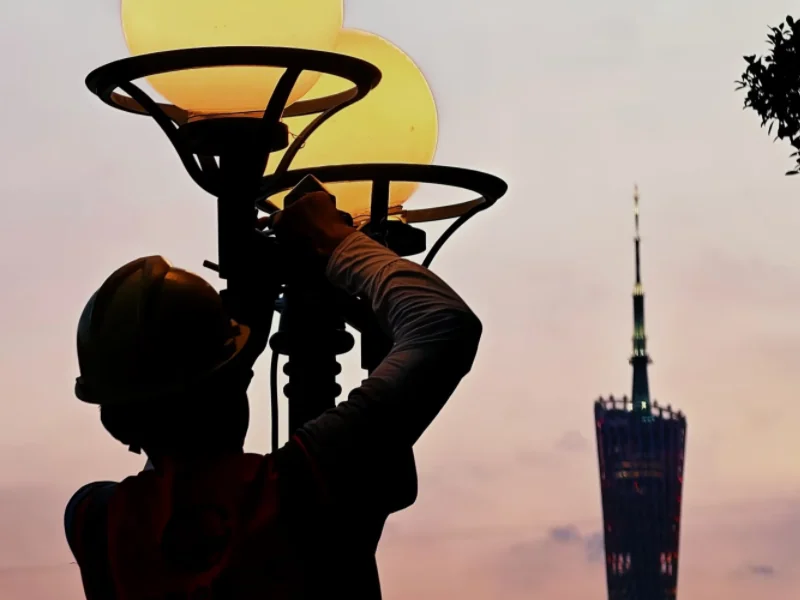
Even a well-specified luminaire will fail if installed poorly. Common mistakes include overtightening that distorts seals, mismatched gland sizes, and leaving junction boxes open during commissioning. Do a proper wet-test after installation — a controlled spray per IP criteria or a simple hose test will reveal weak points. Use thermal imaging during the first week of operation to spot drivers running hot, and log ambient and case temperatures so you can compare against the driver’s derating curve — that’s how you avoid surprises later.
Driver selection and procurement tips for longevity
Driver choice influences lifetime more than the LED module in many installations. Look for drivers with a clear lifetime rating (L70/L80) and published mean time between failures (MTBF). Prefer constant-current drivers with temperature derating and a good power factor; they manage LED stress and electrical efficiency better. For critical networks, specify drivers with onboard surge protection and remote monitoring options — remote fault telemetry can save whole nights of on-site troubleshooting.
Service strategy: inspection intervals and common maintenance steps
Plan maintenance around observed failure patterns rather than arbitrary timeframes. Typical actions include checking gasket condition, re-torquing fasteners, cleaning lenses to maintain photometric performance, and verifying cable gland seals. For high-exposure sites, schedule visual checks quarterly for the first year, then move to semi-annual if conditions stabilise. Keep spare driver modules and pre-sealed cable assemblies on site to minimise downtime — it’s cheaper than full replacement.
Real-world anchor: lessons from coastal installations such as Galle Face Green
Coastal sites like Colombo’s Galle Face Green show how salt spray and strong sun accelerate failure. There, teams moved from IP65 aluminium fixtures with standard paint to IP66 units with powder-coat plus anodised aluminium inserts, combined with silicone gaskets and potting on driver boards. The result: fewer seal failures, reduced rework and longer driver life under constant high humidity. When coastal corrosion is in play, consider custom exterior lighting options that swap in higher-grade materials and tailored sealing details — small up-front cost, big lifecycle gains.
Common mistakes and how to avoid them
Don’t assume a higher IP number alone solves everything — ingress can occur at cable entries, door interfaces or even through condensation if you ignore ventilation and thermal design. Avoid these traps:
– Treat IP as an entire-assembly requirement, not just an enclosure number. – Don’t accept unspecified cable glands or impulse-sealed entries. – Insist on first-article testing under real ambient conditions before bulk install.
These steps reduce warranty claims and improve uptime — which, frankly, the client notices first.
Three golden rules for evaluation and procurement
1) Match IP and materials to exposure, not to a budget wish. A right-sized IP rating plus corrosion-resistant finishes pays back in reduced failures. 2) Specify driver features that directly affect life: temperature derating, surge protection and an explicit MTBF or lifetime Lx rating. 3) Make testing and acceptance concrete: require on-site wet and thermal tests, and tie payment milestones to successful field trials.
When you draw specifications this way, you naturally end up with suppliers who understand field realities — and that’s where a partner like Keyida adds value by matching design, materials and service to the actual operating environment. They’re not just a vendor; they help close the gap between spec and site performance.
– a practical note.